This 13-Yr-Old Launches AI Tool To Help Students Turn Ideas Into Apps
Story Highlights
Kiyan has built KIKA AI that lets users describe an app in plain English and have the AI toold build it. It arrives as AI reaches Indian classrooms faster than the rules for using it.

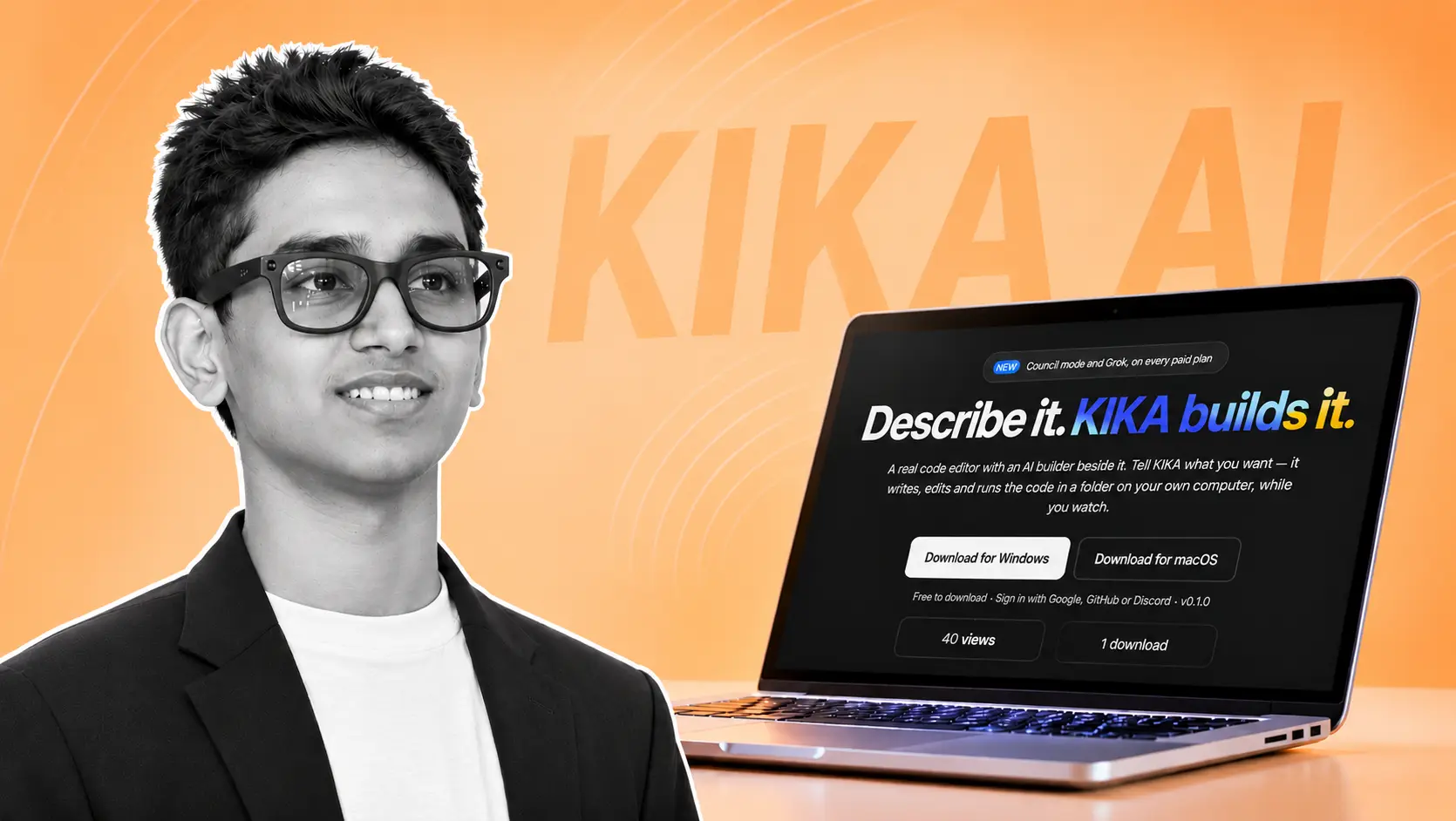
Kiyan has built KIKA AI that lets users describe an app in plain English and have the AI toold build it.
For most schoolchildren with an idea for an app, the hard part used to be the years spent learning a programming language before anything on the screen worked. That wait has now shrunk considerably. A 13-year-old student from Hyderabad has launched KIKA AI, a desktop app that lets users describe a software idea in plain English and have artificial intelligence build it.
Kiyan started the project on 13 July 2026. He says that in 11 weeks he took it from a hand-drawn sketch to a working app with installers for Windows and Mac. The app is free to download from its website, kikaai.in. Users pay for AI usage through credit plans, starting with a ₹49 day pass.
"Honestly, no, I didn't type the code," Kiyan says. "AI wrote almost all of it, mostly Claude Code." Claude Code is an AI coding agent made by Anthropic. "But AI is my partner, and I'm the director. I decide what gets built, how it looks and who it's for, and I test every result myself."
The launch lands in an academic year when CBSE has begun teaching computational thinking and AI from Class 3. Surveys in India and abroad also show students adopting AI tools far faster than schools are writing rules for them. Kiyan's app is a close-up of the shift underneath those numbers: children who grew up consuming technology now have tools that let them direct it.
What KIKA Does?
In plain terms, KIKA is a code editor with an AI assistant built in. Open it and there is a panel where you type what you want, such as a quiz app, a website or a tool for your homework. According to the website, KIKA then reads your project, plans the change and edits the files in a folder on your own computer while you watch. It saves a checkpoint before every change so a mistake can be undone.
It is built on VS Code, Microsoft's free and widely used code editor, which anyone is allowed to adapt. The AI comes from outside companies. Some everyday models are included free. Premium models such as Anthropic's Claude, Google's Gemini Pro and xAI's Grok use credits, and the website prices one credit at about ₹5 of AI cost. It runs on Windows 10 or 11, or on Macs with Apple's own chips.
The app is for people who don't code, though knowing a little helps you steer. Kiyan's own target is narrower. India, he says, has around 9 crore students in Classes 8 to 12, "90 million young people with ideas and no easy way to build them. So on 13 July 2026 I started KIKA AI. You type your idea in plain English, and KIKA builds a full working app. Why at 13? Because I’m the user. I know exactly where students get stuck, because I got stuck there first.”
How a 13-Year-Old Built it?
KIKA began with a frustration. Kiyan liked Python, which he had picked up in school, but with what he knew he couldn't build much. "Mastering a language takes years," he says, "and most of that time goes into learning the language, not solving the problem."
His mama, his maternal uncle, saw his ideas and introduced him to AI coding tools. That helped, until it didn't. He kept getting stuck on the plumbing: terminal commands (instructions typed into a bare text window), error logs (the machine's often cryptic complaints when something breaks) and installing dependencies (the other bits of software a program needs before it will run). "Those tools were built for programmers, not students," he says.
So he set out to build one for students. The design started as his sketch. His proudest moment, he says, was when the VS Code version worked after the very first prompt.
He learned the limits of his AI helpers the hard way. Before KIKA, he built a voice assistant called JARVIS that wasn't hearing him properly. "The AI kept hunting for a bug in the code," he says. "I realised the mic was just too quiet. It took a human to see that."
Along the way he formed views that would sound familiar in a startup's engineering team. In his experience, Claude is strongest at the backend and Gemini at the frontend, so KIKA uses both. He also says he worked out the unit economics: each credit is priced on what the AI really costs, "so no plan can lose money."
By mid-October, Kiyan says, he had spent 57 active days, sent more than 24,000 messages and used 5.7 billion tokens directing AI. A token is a chunk of text, roughly three-quarters of a word, that an AI model reads or writes.
All of this happens after school. He lists his day plainly: school, lunch, a nap, tuition or playing outside, dinner, studying, "and only then KIKA. AI comes after studies, never instead of them."
The tool has already found its way into his schoolwork. This year, he says, the Class 9 syllabus changed so completely that there were no past papers to practise from. So he gave KIKA the last three years' papers for the format, added the new syllabus, and had it build him a fresh practice paper.
He credits his family. The uncle who got him started, parents who were shown every website he built, and a father who suggests what to build next.
The Bigger Picture
Five years ago, a 13-year-old with a sketch and some school Python would have needed years of study to ship a desktop app that takes payments. ChatGPT did not launch until November 2022. In February 2025, AI researcher Andrej Karpathy coined a name for building software by describing it, "vibe coding". By November 2025, Collins Dictionary had made it its word of the year.
Students have moved quickly. In the US, Pew Research Center found that the share of teens using ChatGPT for schoolwork doubled from 13% in 2023 to 26% in 2024. In its fall 2025 survey, 54% said they used AI chatbots for schoolwork. In India, the Central Square Foundation's Bharat Survey for EdTech 2025 covered 12,500 mostly low-income households across 10 states. It found that 35% of school students who use edtech now use generative AI tools for learning. It also found that nearly three in four children who know about these tools think they work like a search engine.
The curriculum is starting to catch up. CBSE's curriculum on computational thinking and AI, announced in a circular dated 1 April 2026, applies to Classes 3 to 8 from the current session.
Industry has moved too. Kiyan cites Google's figure that more than a quarter of its new code is written by AI. Sundar Pichai gave that figure in October 2024. By April 2026, he put it at 75%, with the code still approved by engineers.
The Other Side
Educators' biggest worry is that AI does the thinking. Common Sense Media's August 2026 survey of US teens found that 70% use AI for schoolwork. Nearly two-thirds of those use it in ways that offload critical thinking. In India, the Central Square Foundation survey found that more than 66% of parents and teachers who knew about generative AI believed it amplified risks such as overuse and wrong information.
Kiyan counters the objection. "Many adults still see AI as cheating, but getting the right output from AI is a skill. You have to research, explain exactly what you want and check everything. That's more thinking, not less."
What's Next
KIKA is live and credited on its website to "Kiyan Studio". His father, Kiyan says, already has ideas for what he should build next. He does not think coding is dying, only changing language again. "Languages keep changing, and the newest one is plain English," he says. "So typing code matters less, and thinking matters more."
KIKA began with a frustration. Kiyan liked Python, which he had picked up in school, but with what he knew he couldn't build much. "Mastering a language takes years," he says, "and most of that time goes into learning the language, not solving the problem."
His mama, his maternal uncle, saw his ideas and introduced him to AI coding tools. That helped, until it didn't. He kept getting stuck on the plumbing: terminal commands (instructions typed into a bare text window), error logs (the machine's often cryptic complaints when something breaks) and installing dependencies (the other bits of software a program needs before it will run). "Those tools were built for programmers, not students," he says.
So he set out to build one for students. The design started as his sketch. His proudest moment, he says, was when the VS Code version worked after the very first prompt. He learned the limits of his AI helpers the hard way. Before KIKA, he built a voice assistant called JARVIS that wasn't hearing him properly. "The AI kept hunting for a bug in the code," he says. "I realised the mic was just too quiet. It took a human to see that."
Along the way he formed views that would sound familiar in a startup's engineering team. In his experience, Claude is strongest at the backend and Gemini at the frontend, so KIKA uses both. He also says he worked out the unit economics: each credit is priced on what the AI really costs, "so no plan can lose money."
By mid-October, Kiyan says, he had spent 57 active days, sent more than 24,000 messages and used 5.7 billion tokens directing AI. A token is a chunk of text, roughly three-quarters of a word, that an AI model reads or writes.
All of this happens after school. He lists his day plainly: school, lunch, a nap, tuition or playing outside, dinner, studying, "and only then KIKA. AI comes after studies, never instead of them."
The tool has already found its way into his schoolwork. This year, he says, the Class 9 syllabus changed so completely that there were no past papers to practise from. So he gave KIKA the last three years' papers for the format, added the new syllabus, and had it build him a fresh practice paper.
He credits his family. The uncle who got him started, parents who were shown every website he built, and a father who suggests what to build next.
The Bigger Picture
Five years ago, a 13-year-old with a sketch and some school Python would have needed years of study to ship a desktop app that takes payments. ChatGPT did not launch until November 2022. In February 2025, AI researcher Andrej Karpathy coined a name for building software by describing it, "vibe coding". By November 2025, Collins Dictionary had made it its word of the year.
Students have moved quickly. In the US, Pew Research Center found that the share of teens using ChatGPT for schoolwork doubled from 13% in 2023 to 26% in 2024. In its fall 2025 survey, 54% said they used AI chatbots for schoolwork. In India, the Central Square Foundation's Bharat Survey for EdTech 2025 covered 12,500 mostly low-income households across 10 states. It found that 35% of school students who use edtech now use generative AI tools for learning. It also found that nearly three in four children who know about these tools think they work like a search engine.
The curriculum is starting to catch up. CBSE's curriculum on computational thinking and AI, announced in a circular dated 1 April 2026, applies to Classes 3 to 8 from the current session.
Industry has moved too. In his interview, Kiyan cites Google's figure that more than a quarter of its new code is written by AI. Sundar Pichai gave that figure in October 2024. By April 2026, he put it at 75%, with the code still approved by engineers.
The Other Side
Educators' biggest worry is that AI does the thinking. Common Sense Media's August 2026 survey of US teens found that 70% use AI for schoolwork. Nearly two-thirds of those use it in ways that offload critical thinking. In India, the Central Square Foundation survey found that more than 66% of parents and teachers who knew about generative AI believed it amplified risks such as overuse and wrong information.
Kiyan counters the objection. “Many adults still see AI as cheating, but getting the right output from AI is a skill. You have to research, explain exactly what you want and check everything. That's more thinking, not less.”
What's Next?
KIKA is live and credited on its website to "Kiyan Studio". His father, Kiyan says, already has ideas for what he should build next. He does not think coding is dying, only changing language again. "Languages keep changing, and the newest one is plain English," he says. "So typing code matters less, and thinking matters more."
Trending Videos

Congress Ki Ramlila Rally Mein Kitni Bheed Thi? Rahul Gandhi, Kharge Aur BJP Ka Full Hungama!

Delhi Pollution Returns! AQI Phir Kharab, Saans Le Payegi Delhi? | Air And Yamuna Pollution Crisis

Titan Celestor Swift Review: Fitness-Focused Smartwatch That Gets Most Things Right

Ramlila Maidan Mein Mega Collab! Congress, Rahul Gandhi, Neha Bora, Abhijeet & CJP Ka Kya Hai Scene?

Mard Relationship Mein Kya Chahte Hain?

Wife, Maid Ya Caretaker? Samay Raina Episode Par Bada Sawaal!

2027 Mein Kya Hone Wala Hai? Sumit Acharya Ki Badi Bhavishyavani!

Clear Skin Kaise Milegi? Pimple Kaise Hatayein? | Dr. Jushya Bhatia Sarin

Kya Gyanesh Kumar Ki Kursi Khatre Mein Hai? Tarot Reading

Sonipat: Pitbull Ne Bacche Par Hamla Kyun Kiya? Victim Family Recalls Ordeal

AI Can Kill Humans by 2029?

Aesthetic Culture: Gen Z Ko Aesthetic Kyun Dikhna Hai?