
Amit Dubey: The Cyber Detective Who's Powering India's OTT Thrillers
Story Highlights
Amit Dubey has investigated cyber criminals, trained over 900,000 police personnel, authored nine books, and today, his real investigations are inspiring some of India's biggest web series. His latest collaboration, Pritam Pedro, created with Rajkumar Hirani for JioHotstar, takes cyber storytelling in a different direction altogether.

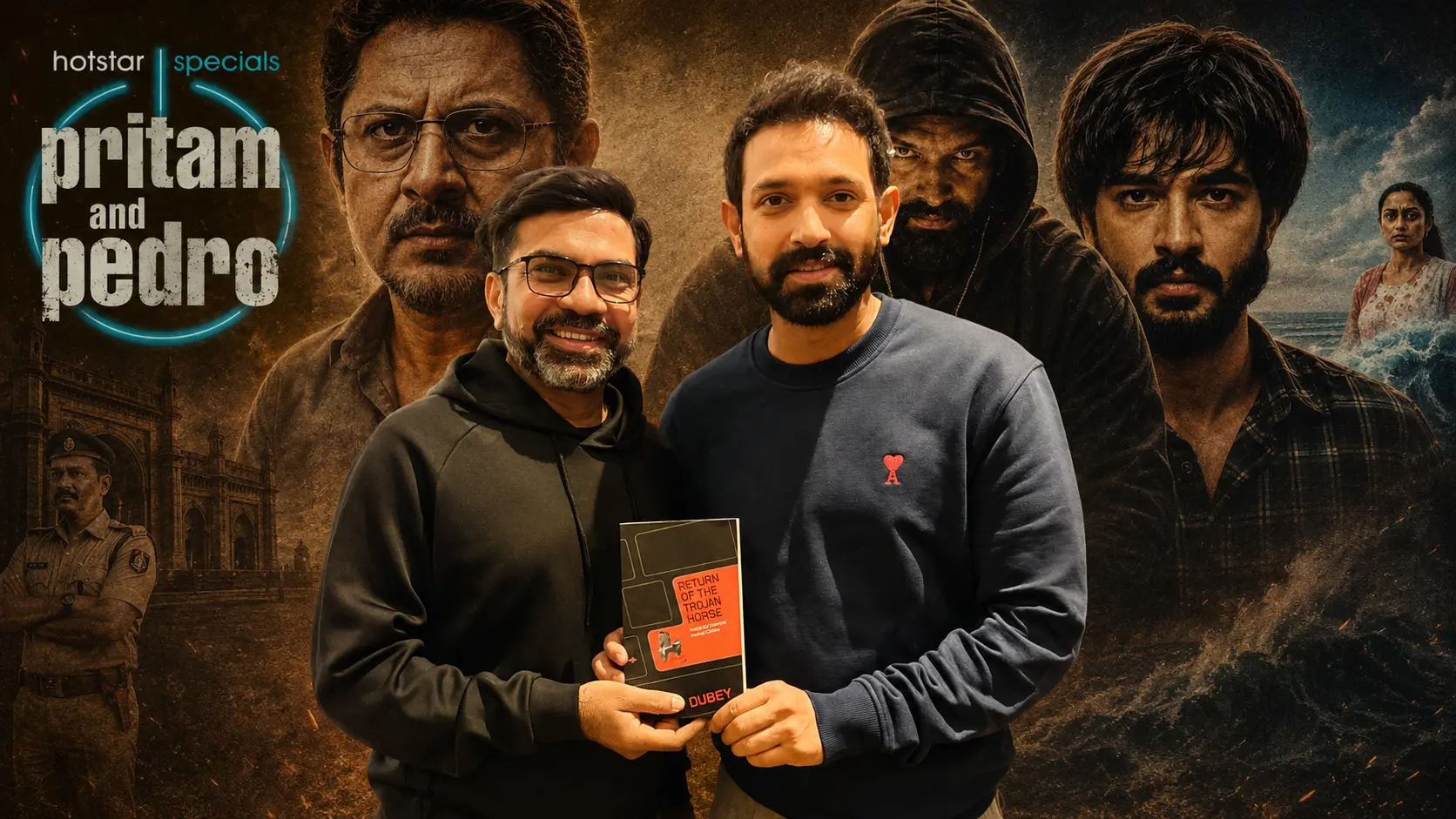
Amit Dubey has investigated cyber criminals, trained over 900,000 police personnel, authored nine books, and today, his real investigations are inspiring some of India's biggest web series.
Every day, millions of Indians receive suspicious messages. Fake investment offers, deepfake videos, phishing emails, scam calls. Most people delete them. Some become victims. Very few ever understand how these crimes are actually investigated. For nearly two decades, Amit Dubey has been one of the people working behind the scenes, helping law enforcement agencies understand, investigate and solve cyber crimes at a time when digital fraud has become one of the fastest-growing threats to modern society.
Today, however, his work has moved far beyond police investigation rooms. The same case files that once helped investigators track cyber criminals are now reaching millions of viewers through bestselling books, radio programmes and some of India's most talked-about OTT productions.
From engineer to cyber investigator
Dubey's story did not begin in a television studio or a film production house. It began with engineering.
After studying at BIET Jhansi, he pursued his postgraduate education at IIT Kharagpur before entering the rapidly evolving world of cybersecurity. This was a period when cyber crime was still emerging as a specialised field in India. Long before phishing, ransomware, cryptocurrency scams and AI-powered fraud became household terms, Dubey had already begun studying how criminals were exploiting technology.
Over the years, he says, he worked alongside Indian law enforcement agencies on more than 1,300 cyber crime investigations — helping decode digital evidence, trace online frauds and map increasingly sophisticated criminal networks.
Building India's cyber investigation capability
While investigations remained a major part of his professional life, another mission gradually became even bigger: training the investigators themselves. As digital evidence became central to almost every serious crime investigation, Dubey began conducting training programmes across the country. According to him, he has trained more than 900,000 police personnel, investigators, judicial officers and government officials in cyber crime investigation, digital evidence, OSINT, artificial intelligence and emerging technologies.
For him, capacity building was never optional. "No investigator can solve tomorrow's crime with yesterday's knowledge," he has often told trainees.
Turning investigation into public awareness
One gap continued to bother him. Police officers understood cyber crime. Most citizens did not.
That gap pushed him to write. Instead of publishing highly technical manuals, Dubey began writing stories drawn from real investigative experience, turning complex cyber cases into narratives an ordinary reader could follow. He has now authored nine books, each attempting to explain not just how digital crimes happen, but why they succeed. His central argument is simple: technology rarely commits fraud. People do. Technology merely becomes the weapon.
When cyber thrillers meet Indian reality
Indian audiences have traditionally associated thrillers with espionage, terrorism and organised crime. Cyber crime remained largely unexplored — until filmmakers began discovering the dramatic potential hidden inside real investigations. Dubey's investigative work inspired Hack Crimes Online, produced by Neeraj Pandey for Amazon Prime Video. He later contributed creatively to Special Ops 2, continuing his association with technology-driven storytelling.
His latest collaboration, Pritam Pedro, created with Rajkumar Hirani for JioHotstar, takes cyber storytelling in a different direction altogether. Rather than treating cyber crime purely as a thriller, the series blends humour, emotion and human relationships.
Six years, sixteen drafts, one story
Audiences see the final product. They rarely see the years of rewriting behind it. According to Dubey, Pritam Pedro took almost six years to develop, with the screenplay going through 16 complete drafts before reaching its final version. Every rewrite brought a new perspective. "Rajkumar Hirani constantly searches for emotional truth inside every story," Dubey says. "He wants audiences to laugh, connect emotionally and leave with a meaningful message."
That philosophy, he believes, transformed what could have been a conventional cyber thriller into something far more human.
Working with two schools of storytelling
Having collaborated with both Neeraj Pandey and Rajkumar Hirani, Dubey says the experience exposed him to two entirely different filmmaking sensibilities. Pandey, he says, is a master of suspense — precise, tightly structured, relentlessly thrilling. Hirani approaches stories differently, searching for hope, for emotion, for humanity.
"He has an extraordinary ability to make people laugh while discussing serious subjects," Dubey says.
The combination has produced a storytelling style rarely explored in Indian entertainment: a cyber crime narrative driven as much by human emotion as by digital investigation.
The voice beyond books
Long before streaming platforms embraced cyber crime, Dubey was already taking the subject to ordinary citizens through radio. His cyber awareness programmes explained digital threats in plain language, helping families, students and senior citizens understand how online scams actually work.
It was another extension of the same mission — awareness before victimhood, education before investigation.
More than entertainment
Artificial intelligence is making scams smarter. Deepfakes are becoming more convincing. Cyber fraud now crosses borders within seconds. In this shifting landscape, investigators, educators and storytellers are increasingly working toward the same objective: helping society understand risks before people become victims. Dubey's unusual career brings all three roles together — engineer, cyber investigator, police trainer, author, radio host, screenwriter. Each chapter looks different. Yet all of them are driven by a single idea: making the invisible world of cyber crime visible to ordinary people.
Because every cyber crime story carries two endings. One ends in a courtroom. The other begins when society learns enough to prevent the next victim. Perhaps that is why Amit Dubey's journey is no longer just about solving cyber crimes. It is about changing how India understands them.
His latest collaboration, Pritam Pedro, created with Rajkumar Hirani for JioHotstar, takes cyber storytelling in a different direction altogether. Rather than treating cyber crime purely as a thriller, the series blends humour, emotion and human relationships.
Six years, sixteen drafts, one story
Audiences see the final product. They rarely see the years of rewriting behind it.
According to Dubey, Pritam Pedro took almost six years to develop, with the screenplay going through 16 complete drafts before reaching its final version. Every rewrite brought a new perspective. "Rajkumar Hirani constantly searches for emotional truth inside every story," Dubey says. "He wants audiences to laugh, connect emotionally and leave with a meaningful message."
That philosophy, he believes, transformed what could have been a conventional cyber thriller into something far more human.
Working with two schools of storytelling
Having collaborated with both Neeraj Pandey and Rajkumar Hirani, Dubey says the experience exposed him to two entirely different filmmaking sensibilities. Pandey, he says, is a master of suspense — precise, tightly structured, relentlessly thrilling. Hirani approaches stories differently, searching for hope, for emotion, for humanity. "He has an extraordinary ability to make people laugh while discussing serious subjects," Dubey says.
The combination has produced a storytelling style rarely explored in Indian entertainment: a cyber crime narrative driven as much by human emotion as by digital investigation.
The voice beyond books
Long before streaming platforms embraced cyber crime, Dubey was already taking the subject to ordinary citizens through radio. His cyber awareness programmes explained digital threats in plain language, helping families, students and senior citizens understand how online scams actually work.
It was another extension of the same mission — awareness before victimhood, education before investigation.
More than entertainment
Artificial intelligence is making scams smarter. Deepfakes are becoming more convincing. Cyber fraud now crosses borders within seconds. In this shifting landscape, investigators, educators and storytellers are increasingly working toward the same objective: helping society understand risks before people become victims. Dubey's unusual career brings all three roles together — engineer, cyber investigator, police trainer, author, radio host, screenwriter. Each chapter looks different. Yet all of them are driven by a single idea: making the invisible world of cyber crime visible to ordinary people.
Because every cyber crime story carries two endings. One ends in a courtroom. The other begins when society learns enough to prevent the next victim. Perhaps that is why Amit Dubey's journey is no longer just about solving cyber crimes. It is about changing how India understands them.
Trending Videos

Sonipat: Pitbull Ne Bacche Par Hamla Kyun Kiya? Victim Family Recalls Ordeal

AI Can Kill Humans by 2029?

Aesthetic Culture: Gen Z Ko Aesthetic Kyun Dikhna Hai?

Women's Mental Health: What is Postpartum Depression

Kya 2029 Tak Jari Rahega PM Modi Ka Rajyog? Astrology Decoded

Marghat Wale Hanuman Mandir Ka Rahasya
Gurugram Hit & Run: Women Bikers Should Be More Careful?

Can Gen Z Live Without A Phone For One Day?

Swara Bhaskar’s Remarks Spark Controversy!

Operation Safed Sagar Cast on Kargil Stories

Can Gen Z Survive Without Memes? IMPOSSIBLE! Fun or Full-Blown Addiction?

26 Pahalgam Files: Detailed stories of the families in Pahalgam Attack

Archana Puran Singh Responds to Samay Raina: What Is the Debate Really About?